In this issue
Have a beautiful water image that you'd like to share with AWRA-CO? Email your images to [email protected] and we will use them (and give photo credit) on our social media accounts. Follow us on our all of our social media, and check our Linked In for more professional article references.
Looking to start your career in water resources or ready to change rolls with your current career? AWRA-CO posts new job opportunities to our Careers page. Check back for new postings regularly.
AWRA-CO Summer/Fall 2022 Newsletter 
Richard Herbert Memorial Scholarship Recipients
2020/2021 Scholarship Recipients – Update on Research
Due to COVID and other circumstances, the students who received Richard Herbert Memorial Scholarships for the 2020/2021 academic year did not present their research at a symposium. Instead, they have provided AWRA –
Colorado with summaries of their research for this newsletter. The list below provides general information on the four recipients, and we encourage you to follow this link to delve more into these interesting topics.
Nick Chohan
Colorado State University, Department of Geosciences, MS
Advisor: Dr. William E. Sanford
Topic: Determining the contribution of high-altitude wetlands to baseflow in the Senator Beck Basin, San Juan Mountains, Colorado.
Emily Iskin
Colorado State University, Geosciences, PhD
Advisor: Ellen Wohl
Topic: Quantifying Floodplain Spatial Heterogeneity with Respect to Potential Control Variables in the US.
Maryam Sahaar
Colorado State University, Department of Ecosystem Science and Sustainability, BS
Advisor: Steven R. Fassnacht
Topic: Snowmelt and timing of peak flow - does a long-term increase in temperature changes the timing of peak streamflow?
J.C. Suhr
Colorado State University, Geosciences, MS
Advisor: Dr. Sara Rathburn
Fall 2021 (resume)
Topic: Alluvial Dynamics of the South Fork Cache la Poudre River Valley, Colorado.
Please consider making a contribution to the Richard Herbert Memorial Scholarship fund at the following link.
AWRA-CO Mentorship Program
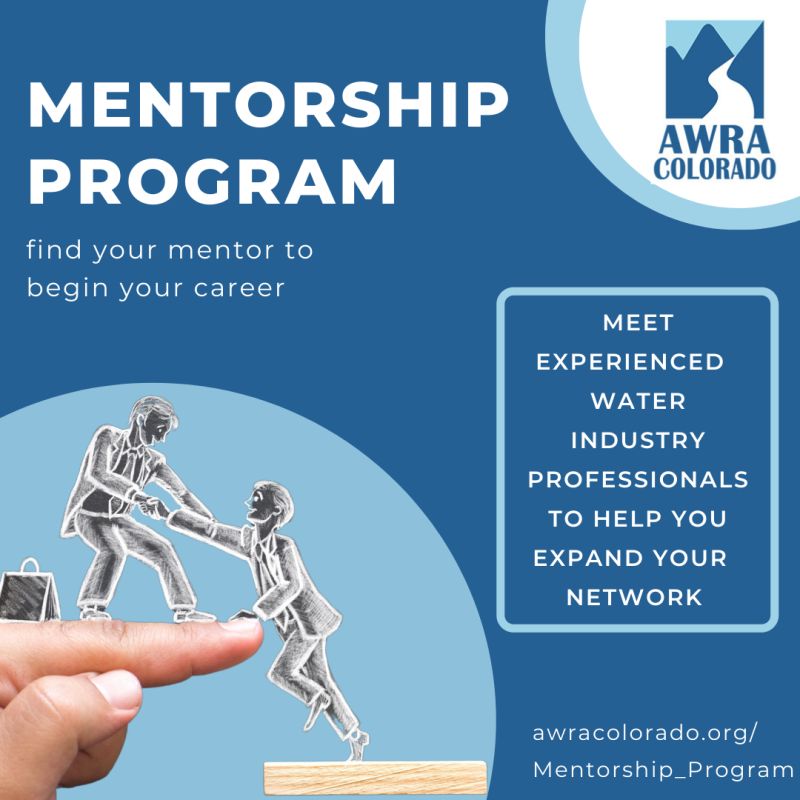
We highlighted this in our last newsletter but wanted to give it a shout-out again as AWRA-CO is now offering a mentorship program for any actively enrolled college students interested in pursuing a career in the field of water resources in Colorado. AWRA-CO will match mentees with an experienced industry professional based on shared career interests. Our goal for this program is to create lasting professional relationships that provide value to individuals and strengthen our local water resources community as a whole.
Apply and get more details here: https://awracolorado.org/Mentorship_Program
Lunch Talk Recaps
September Lunch Talk - Lawn Irrigation Contributions to Semi-Arid Urban Baseflow
Aditi Bhaskar, Assistant Professor in the Department of Civil and Environmental Engineering at Colorado State University, presented their study on excess lawn irrigation and it's impacts on baseflow. This work gives a new way to analyze how much flow is coming from different sources in urban areas, which is important for understanding consequences for water quality and water rights for downstream users.
October Lunch Talk - Improving Tradeoff Understanding in Water Resource Planning Using Multi-Objective Search
Leon Basdekas, P.E., Ph.D., Upper Columbia Senior Water Manager for the Seattle District, U.S. Army Corps of Engineers, gave a brief introduction to multi-objective search and then presented the four different case studies conducted as part of Water Research Foundation project 4941. The case studies included 4 different utilities that looked at long-term storage, reservoir rule curve development, reservoir operations, and source water allocation timing and budget impacts.
November Lunch Talk - Updates on the Colorado River
Amy Ostdiek, the Section Chief of the Interstate, Federal, and Water Information Section at the Colorado Water Conservation Board, presented on Colorado River matters, including an overview of relevant background and context, an update on implementation of the 2007 Interim Guidelines and Drought Contingency Plan, and next steps.
Missed a Past Lunch Talk?
As a reminder, members can access presentation materials and recordings of past lunch talks on our website in the member portal: https://awracolorado.org/
Colorado Water History
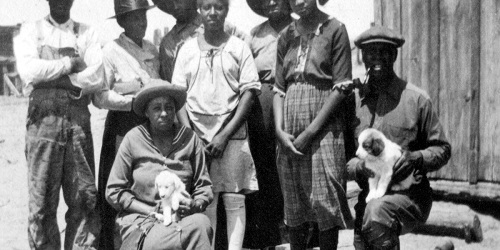
In honor of Black History Month we wanted to share the story of Dearfield, CO. Founded in 1910 by Oliver Toussaint Jackson who had a vision of a thriving African-American settlement not far from Denver. It has been documented that there were 25 black communities in Colorado in the early 1900s but Dearfield was the only Black agricultural community. For about the first decade of the town being founded the farming became well established due to the climate and the amount of rainfall that the area had, which incrementally decreased each year. The town was able to raise surplus crops known as "truck garden" crops as they would drive them to nearby markets and sell potatoes, strawberries, alfalfa, corn and more. The town was even described as being lush at the time. They also got a boost in the economy during World War I with price surges for produce. By 1930 with the dwindling rainfall and the onset of the Dust Bowl, the town population was a meager 25 and it was hard to get people to come back to the once flourishing town. Ultimatley the lack of rain and dust storms led to the towns demise.
A documentary was made in 2020 documenting oral and written histories of Deartfield and it's founder and can be found at the link here.
